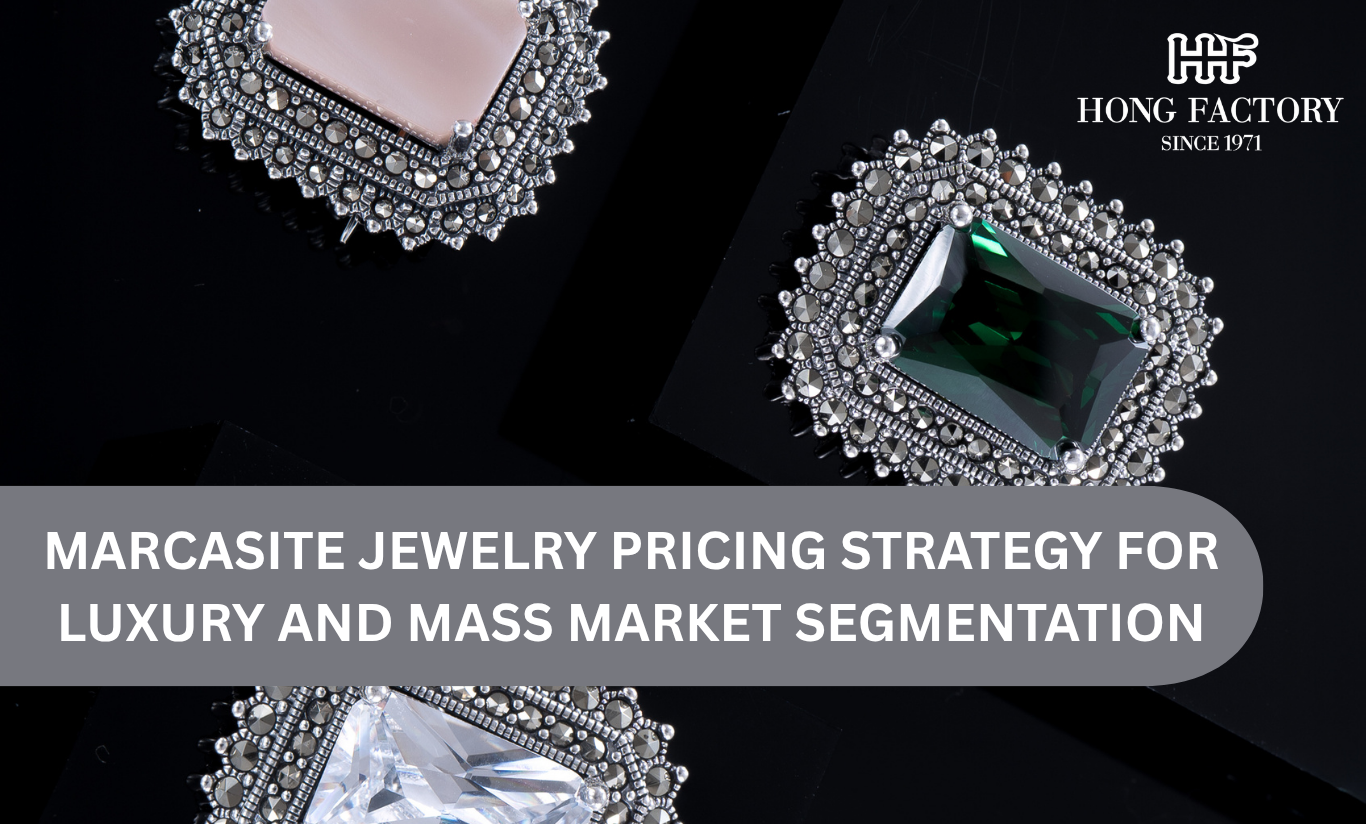
Marcasite Jewelry pricing strategy for luxury and mass market segmentation to maximize revenue and brand reach
Why segmentation-based pricing matters
Different customers have different willingness to pay. A single pricing model leaves money on the table or weakens brand perception. Segmenting your pricing into luxury and mass market tiers allows you to capture multiple customer groups while protecting margins and positioning.
For marcasite jewelry, this is especially powerful because the same material (silver + marcasite) can be presented as affordable fashion or premium heritage craftsmanship depending on execution.
Understanding luxury vs mass market buyers
Luxury segment focuses on:
- Exclusivity and uniqueness
- Craftsmanship and story
- Brand prestige
Mass market segment focuses on:
- Affordability
- Trend relevance
- Accessibility
Your pricing must reflect what each segment values.
Creating clear product tiers
Build structured tiers:
- Entry (mass): simple designs, competitive pricing
- Mid-tier: balanced design + quality
- Premium (luxury): unique, limited, handcrafted
Clear tiers reduce confusion and guide purchasing decisions.
Differentiating products beyond price
Avoid selling the same product at different prices. Instead differentiate:
- Design complexity
- Stone quality and finishing
- Packaging and presentation
Real differences justify pricing gaps.
Luxury pricing strategy techniques
Position for premium perception:
- Higher, consistent pricing (no frequent discounts)
- Limited editions or numbered pieces
- Story-driven product positioning
Luxury pricing signals value and exclusivity.
Mass market pricing strategy techniques
Optimize for volume:
- Competitive price points
- Promotions and bundles
- Fast-moving designs
Mass pricing increases reach and sales frequency.
Using psychological pricing across segments
Apply different tactics:
- Mass: charm pricing (e.g., $49, $99)
- Luxury: rounded or prestige pricing (e.g., $200, $500)
Presentation influences perception.
Channel-based pricing alignment
Adjust pricing by channel:
- Website vs marketplaces (account for fees)
- Retail vs wholesale margins
Maintain overall consistency to avoid conflict.
Packaging and experience as price multipliers
Enhance perceived value:
- Premium packaging for luxury lines
- Simple, cost-efficient packaging for mass
Experience supports pricing power.
Managing discounts without harming brand
Control promotions:
- Use limited-time offers for mass segment
- Avoid discounting luxury lines
Protect long-term brand value.
Data-driven pricing optimization
Use analytics to refine:
- Conversion rate by price point
- Margin by SKU
- Price elasticity testing (A/B tests)
Adjust pricing based on performance, not assumptions.
Preventing cannibalization between tiers
Ensure clear separation:
- Distinct designs and messaging
- Different marketing channels if needed
Avoid overlap that confuses customers.
Communicating value effectively
Make pricing make sense:
- Explain craftsmanship and materials for premium items
- Highlight affordability and style for mass items
Clear messaging improves acceptance.
Scaling segmentation over time
Expand strategically:
- Introduce new premium lines once brand trust grows
- Add entry products to capture new customers
Balanced growth increases total revenue.
Common segmentation pricing mistakes
- Mixing luxury and discount messaging
- Pricing too close between tiers
- Lack of clear differentiation
Clarity is critical for success.
SEO strategy for pricing segmentation content
Target keywords such as “pricing strategy,” “market segmentation pricing,” and “marcasite jewelry pricing.” This attracts business users.
Internal linking for pricing ecosystem
Link this article to bundling, CRO, branding, and wholesale pricing topics.
Content structure for readability
Use H1, H2, and H3 headings with bullet points for clarity and scannability.
Expanding keyword variations naturally
Include terms such as “value-based pricing,” “price segmentation,” and “brand positioning pricing” to enhance SEO.
Conclusion
Marcasite jewelry pricing strategy for luxury and mass market segmentation enables businesses to maximize revenue while building strong brand positioning. By clearly separating product tiers, aligning pricing with value, and optimizing based on data, brands can serve multiple audiences without compromising identity.
For SEO and PBN strategies, segmentation-focused pricing content supports both authority and long-term profitability.